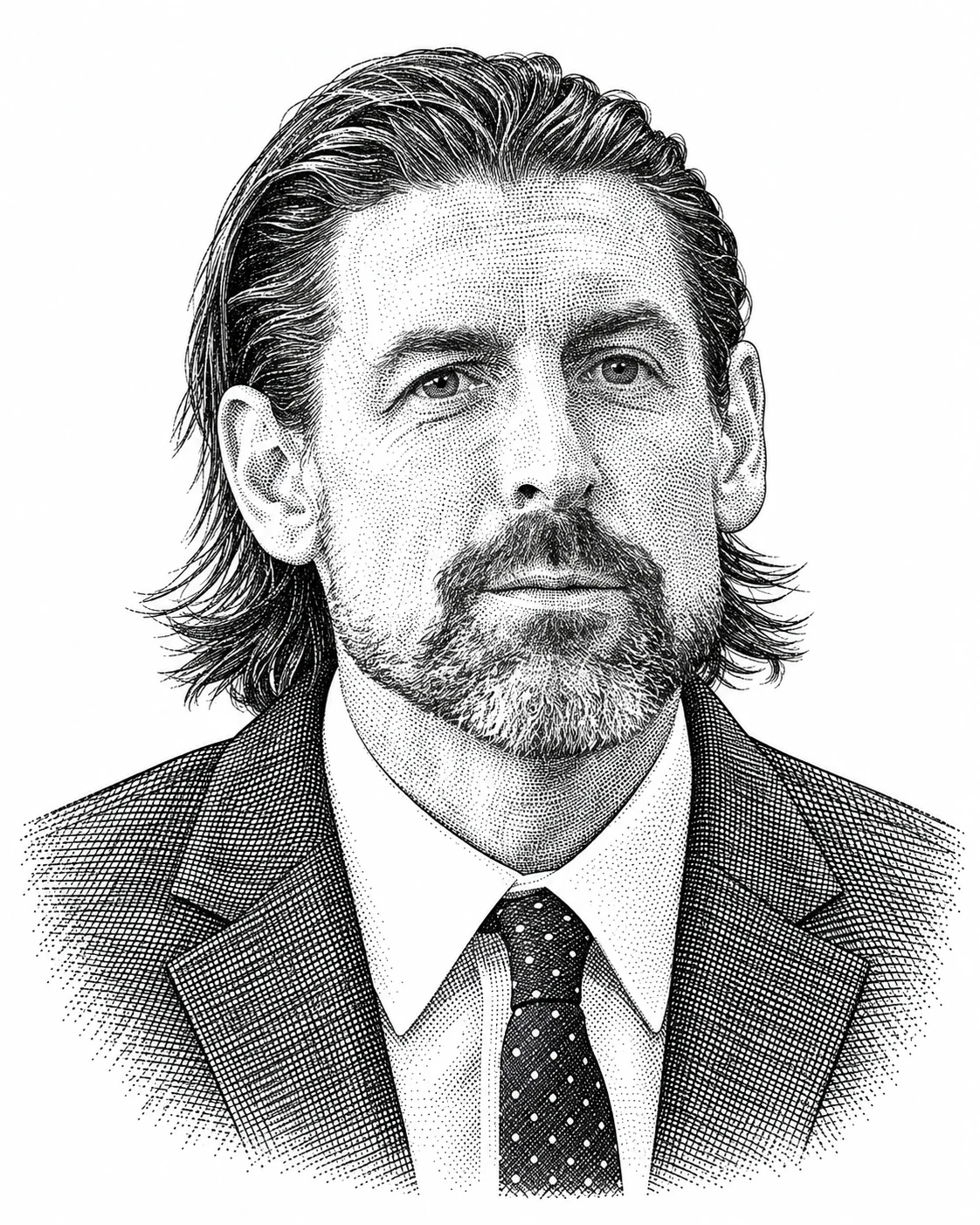
The person
Presti grew up in Concord, Massachusetts, and captained the basketball team at Emerson College in Boston. He got into the NBA by talking his way into a counselor job at a camp run by Gregg Popovich and R.C. Buford, then talking Buford into an internship in San Antonio at $250 a month. Within a few years he was the Spurs' assistant GM.
In 2007, Clay Bennett hired him to run the Seattle SuperSonics. He was the youngest GM in the league. The team moved to Oklahoma City a year later, and Presti has run it ever since: nearly 20 years, two complete build cycles, one owner.
The first cycle produced three future MVPs drafted in three straight years: Kevin Durant, Russell Westbrook and James Harden. The second produced a champion. He was named NBA Executive of the Year for 2024-25, the season the Thunder won the title.
Away from the office, he plays drums, loves jazz and meditates. It fits an executive whose signature word is patience.
In Front Office Watch terms, Presti came through the apprenticeship door, Spurs branch. And unlike Mike Gansey in Philadelphia, there's no executive layer between him and ownership. He leads Oklahoma City's basketball operation, although ownership's financial limits are not fully public.
The hand he holds
Presti's problem this summer was the opposite of most executives': he had too much good roster to pay for.
The Thunder won the 2025 title, then won 64 games last season before losing Game 7 of the Western Conference finals to the Spurs. Jalen Williams missed 49 games. Presti says the team "never really played with a full team."
Shai Gilgeous-Alexander is the two-time reigning MVP. Chet Holmgren made his first All-Star and All-NBA teams. Williams is back. And their pay is about to explode. The three stars made $58.5 million combined last season. This season it's $123.8 million, and next season $150.8 million. Before the summer's moves, OKC's payroll projected to $250.5 million, far past the second apron, the league's toughest spending limit.
FOW's phase call: Sustain. Oklahoma City ended the Finals with Gilgeous-Alexander as a confirmed cornerstone and one of the league's strongest overall structures. In Sustain, the job isn't to freeze a contender in place. It's to preserve its championship position while refreshing the pieces around it.
Defining decisions, so far
1. Trading James Harden (October 2012). Months after a Finals run, Harden turned down a four-year offer worth up to $54 million. With ownership reluctant to pay the luxury tax, Presti traded him to Houston for Kevin Martin, Jeremy Lamb and picks. "We were unable to reach a mutual agreement," he said. Harden became an MVP. It's the move his critics still bring up first, though how much of the spending limit was Presti's call and how much was ownership's has never been public.
2. Turning a star's exit into a future (July 2019). Paul George pushed for a move to the Clippers. Presti said at the time the Thunder didn't want to break up the team. He turned the exit into Shai Gilgeous-Alexander and a pile of first-round picks, four of them unprotected, then sent Russell Westbrook to Houston for Chris Paul, two more firsts and two pick swaps. Those picks became the raw material for everything since, including Jalen Williams at No. 12 in 2022. Chet Holmgren came at No. 2 the same night.
- The situation: a star who wanted out, on a team that wasn't a contender without him.
- What he got: the core of a champion.
3. Selling three rotation players to keep the stars (summer 2026). Facing that payroll jump, he traded Isaiah Joe to Detroit, Aaron Wiggins to Atlanta and Lu Dort to Atlanta in a three-team deal, all for second-round picks. Then he re-signed Isaiah Hartenstein, drafted 7-foot-3 center Aday Mara at No. 12, moved up one spot for guard Bennett Stirtz, and in October gave Cason Wallace a five-year, $139 million extension.
- What he gave up: about 10,000 minutes, by his own count more than a quarter of the team's playing time over the past two seasons, including Dort, a 2025 All-Defensive first-teamer.
- What he kept: all three stars, and a payroll below the second apron.
Presti was unusually direct about why. "This was a financial decision," he told The Oklahoman after the Dort trade. The savings from this summer and from years out of the luxury tax, he said, "will be reallocated to future teams," and the moves "positioned us financially to maintain a team of this caliber." Keeping everyone would have been allowed. Oklahoma City chose not to pay for it, and pointed to where the money is expected to go instead.
The pattern
Presti may be the easiest executive in the league to read, because he has been saying the same thing for years.
In 2022, mid-rebuild: "Trying to fix things quickly takes a very long time." In 2023, as his young team started winning: "We have to finish our breakfast before we start acting like we're on the cusp of something." The goal, he said, was "sustained high performance over a long period of time." This September: "We've said the same things when we were winning 23 games as we were when we were winning 68 games."
His moves match his words. Nearly 20 years of decisions show three clear habits:
- He turns situations he didn't choose into future assets. Harden turned down OKC's offer. George pushed his way out. Both times he came back with assets, though not equally good ones. Harden returned Kevin Martin, Jeremy Lamb and picks, one of which became Steven Adams. George returned the core of a champion. Patience gets the credit, but turning bad news into assets is the rarer skill.
- He develops players rather than buying them. The title core was drafted or acquired with rebuild assets. When he traded Dort, he framed it as a vote for a younger player: it "is how highly we think of Cason."
- He guards the payroll. The Thunder stayed under the luxury tax for six straight seasons, and this summer he called the sell-off "a financial decision." How much of that is Presti's preference and how much is ownership's budget isn't public.
He also names a goal: "sustained high performance over a long period of time." What he never gives is a yardstick: no win total, no deadline, no definition of failure. "We don't know how many games we're going to win this year," he said in September. "We're not entitled to anything."
The strongest case against our read. Some of the success was luck: the Clippers' picks landed well, and Williams, taken 12th with one of them, became a star. The Harden trade shows the same discipline can cost a title window. And "we don't know how many games we'll win" is humble, but it protects him from being caught short almost as well as Gansey's "you don't know what's going to happen."
The FOW read
Presti spent nearly two decades building the case for patience, development and financial flexibility. It produced a champion. Now he faces a different test: he already has a title team, and keeping it intact became extraordinarily expensive.
Oklahoma City chose to give up three established contributors for financial relief, future picks and Presti's expectation that the savings would go to future teams. Moving pieces before they age out and betting on the development system is consistent with Sustain. Mara also makes the Thunder bigger at a moment when that matters, with San Antonio standing between them and another Finals.
But a move that fits the phase isn't automatically the right move. Sometimes sustaining a champion means paying an extraordinary price to keep a rare chance alive.
- Strongest case: this organization has repeatedly turned young, inexpensive players into real contributors while keeping its draft flexibility.
- Main caution: a lot of perimeter defense and shooting left at once. Until OKC fails to replace it, the stronger evidence says they usually find the next guy. But two other questions are live: the season ended against a Spurs team built around Victor Wembanyama, and Mara only answers that on paper so far. And the next squeeze is already scheduled, when Wallace's extension starts next year on top of three max-level stars.
Our early read: cautiously favorable. Presti has credible replacements, a proven development system and plenty of future flexibility. But the trade-off is real: he weakened a contender today to protect its ability to contend tomorrow. The unanswered question is whether protecting the next title chance has started to cost Oklahoma City part of the one it already has.
That sets up a useful contrast with Mike Gansey. Gansey was hard-capped this summer, so staying under the apron was a rule; the choices were what he paid to fit inside it. Oklahoma City wasn't. Its sell-off was a choice, which makes it more revealing. How much was Presti's preference and how much was ownership's budget isn't public. But Presti gave the explanation himself, so he owns it.
Watch him now
Four decisions will tell us whether the long game still works:
- If the perimeter defense slips. Does Presti spend from his stack of picks at the trade deadline, or trust the development system to find the next Dort?
- Aday Mara. Does the rookie earn a real role against the bigger teams the Thunder are likely to see in May? It's a direct test of the draft call he made right after losing to Wembanyama.
- The next squeeze. When Wallace's extension starts next year, does Presti sell another good player early, or pay a big tax bill to keep the group together?
- The reinvestment test. Presti said he expects this summer's savings to go to future teams. When the next big money decision arrives, does Oklahoma City actually spend it? That one isn't Presti's call alone, but it tests the reason he gave.
Gansey's open question is whether he knows when to walk away. Presti's is whether he knows when it's time to stop waiting.